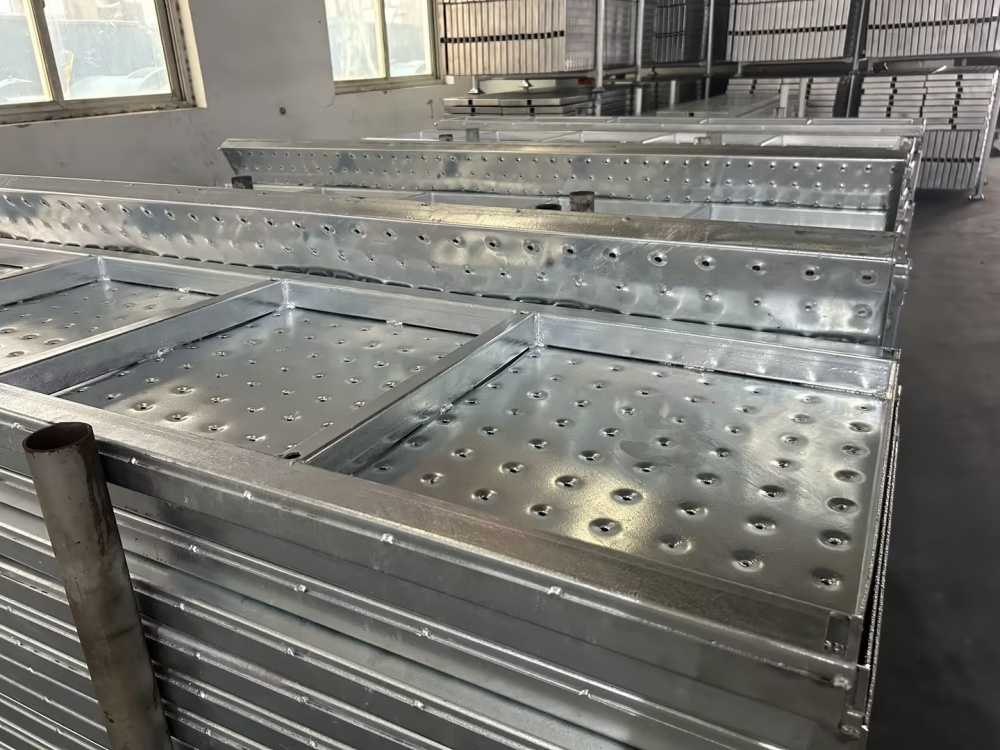
Scaffolding planks are essential components of scaffolding systems, commonly used to construct sturdy elevated platforms that allow workers to access heights for construction, maintenance, or repair tasks. These scaffolding planks are typically manufactured from high-quality materials such as aluminum alloy, steel, or wood, featuring mechanically embossed or perforated anti-slip surfaces designed to resist corrosion and withstand harsh weather conditions.
Advantages of Scaffolding Planks
High load-bearing capacity: Made from high-quality metal, they support heavy loads suitable for demanding construction work. Strong corrosion resistance: Capable of withstanding moisture and extreme weather. Good fire resistance: Metal materials are ideal for high-temperature work environments. Low maintenance: Requires minimal upkeep, is easy to clean, and offers a long service life. Long lifespan: Durable and reusable.
Safety Guidelines for Using Scaffolding Planks
1. Inspect planks to ensure there are no cracks, notches, or obvious structural damage. 2. Planks must feature anti-slip properties; surfaces should be perforated or embossed to facilitate drainage and prevent slipping. 3. Load-bearing capacity must meet project requirements; planks should exhibit minimal deflection under expected loads, and the specified weight limit must never be exceeded. 4. Ensure planks are securely fastened to prevent sliding, tilting, or shifting; planks should extend approximately 12 inches (approx. 30 cm) beyond their support points. 5. Avoid using planks with hidden defects, such as those covered in thick layers of paint or dried mortar/plaster. 6. Avoid overloading; if a plank deflects (bends) by more than 1/60 of its length during use, it indicates the load limit has been exceeded. 7. Avoid using uncertified planks to prevent sudden structural failure during use.
What Requirements Must Scaffolding Planks Meet?
1. Scaffolding planks must be sturdy and safe. The materials used must possess sufficient thickness and strength to support the combined weight of personnel and tools.
2. Planks must allow for precise joining. Scaffolding planks should fit together precisely; all planks must maintain consistent dimensions and thickness. There should be no gaps between joined sections; if significant gaps exist, filler plates must be used to bridge them.
3. Keep the tread surface free of accumulated debris. The tread surface should be mechanically embossed or perforated to provide slip resistance and prevent the accumulation of rainwater or dirt. If the surface of metal scaffolding planks is covered by accumulated rainwater, mortar, or other substances, it becomes impossible to accurately assess the condition of the planks.
4. Distribute loads evenly and prevent overloading. Be aware of the load-bearing limits of the scaffolding planks; distribute loads evenly during use and never exceed the maximum load capacity specified by the manufacturer.
Maintenance and Storage of Scaffolding Planks
1. Regularly remove dirt, debris, and contaminants: Avoid using chemicals or cleaning agents that could damage the scaffolding plank material. 2. Apply protective coatings or anti-corrosion treatments: Apply protective coatings—such as anti-corrosion paint—to the planks, or purchase galvanized metal planks. 3. Storage: Store scaffolding planks in a dry, secure location to prevent moisture damage or other deterioration.
Conclusion
Scaffolding planks serve as the platform supporting workers at heights within a scaffolding system; therefore, they must be used in accordance with regulations. Improper use can result in injury to personnel or damage to property. EK Scaffolding manufactures and sells a wide range of scaffolding planks, including LVL scaffolding plank, aluminum scaffolding plank, and steel scaffolding plank. We use high-quality raw materials and adhere strictly to manufacturing standards; all our scaffolding planks meet local certification requirements, providing safe and reliable platforms for high-altitude work on construction projects.